Free Shipping on $50 Orders

Raymond V. Roberts
Athletic Trainer and Originator of Wrestling Safety
1/6/20262 min read
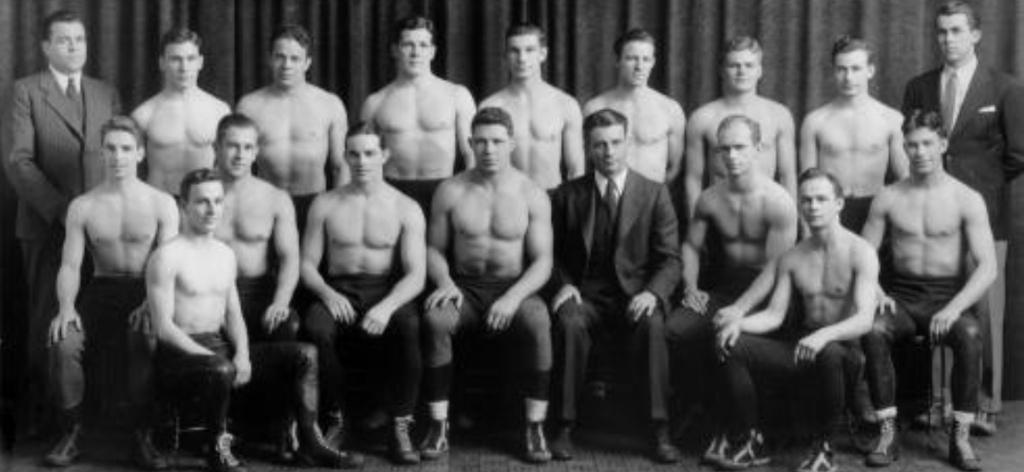
Raymond V. Roberts, born around 1910 in Michigan, dedicated his career to athletic training and sports safety, leaving a quiet but significant legacy in protecting athletes—particularly wrestlers—from debilitating injuries. His hands-on experience with elite programs and inventive spirit produced one of the earliest patented designs for wrestling-specific headgear, predating more commercialized versions and marking him as a true pioneer in the field.
Early Career and Foundations in Athletic Training
Roberts began his journey in sports medicine at the United States Military Academy (West Point), serving as assistant athletic trainer in the late 1920s. This demanding role immersed him in injury management for high-intensity training, building expertise that would define his contributions. In1930, he advanced to head athletic trainer at the University of Michigan, a position he held for 17 years until approximately 1947. At Michigan, Roberts was the backbone of the Wolverines' athletic program during a powerhouse era. He treated injuries, prepared athletes for competition, and innovated treatment methods across sports. University yearbooks highlight his impact: by 1931, he led a training staff; in 1934, he supported varsity teams; and in 1943—his 13th year—he was celebrated for hands-on care, such as massaging players and rehabilitating stars like football captain George Ceithaml. His accomplishments extended to professional football in 1947, when he served as trainer for the Detroit Lions, applying collegiate techniques to the NFL. Roberts' tenure coincided with Michigan's wrestling dominance under legendary coach Cliff Keen (1925-1970), with whom he collaborated closely. This partnership exposed him firsthand to wrestling's unique risks, especially cauliflower ear from repeated trauma—a problem with no standardized solution at the time.
Groundbreaking Innovation: The First Patented Wrestling Headgear
Roberts' most enduring accomplishment came from his inventive response to these challenges. On December 9, 1940, he filed U.S. Patent 2,277,994 for "Athletic Headgear," granted on March 31, 1942. This design—explicitly tailored for wrestling—featured padded ear guards with marginal flanges and U-shaped resilient padding, secured by straps to protect the ears while allowing freedom of movement. It represented the first patented wrestling-specific headgear, addressing cauliflower ear prevention years before the sport's post-war boom in protective equipment.
This 1942 patent predates later designs, including Roberts' own 1959 refinement (US 2,886,818) and Cliff Keen's contemporaneous 1959 patent that led to commercial success. Roberts' early work, born from his trainer's perspective at Michigan, laid critical groundwork for the modern ear guard, emphasizing practical, athlete-focused protection.
Later Years and Enduring Influence
After leaving Michigan, Roberts relocated to Manitou Springs, Colorado, by the late 1950s, where he filed his second headgear patent in 1958. He remained connected to wrestling, appearing in NCAA Wrestling Guides (1966, 1969, 1972) as a respected figure alongside Keen. Roberts passed away at age 65 in a Phoenix, Arizona hospital, survived by his wife Ellen M. Roberts and children, including son Raymond W. Roberts Jr. Though often overshadowed by commercial brands, Raymond V. Roberts' accomplishments—as a trainer safeguarding icons at Michigan and the Lions, collaborator with Cliff Keen, and holder of the earliest wrestling headgear patent—cement his place as a foundational innovator. His 1942 design helped transform wrestling from a sport where ear deformities were a rite of passage to one prioritizing safety, influencing generations of protective gear. Roberts exemplifies the unsung heroes of athletics: those who, through expertise and invention, quietly elevated the game.
Check Us Out on Socials #ShotShield
Contact
shotshieldgear@gmail.com
© 2026. All rights reserved.
The ShotShield Cushion Insert product line is a supplemental foam padding accessory designed for use with approved wrestling headgear. It is intended only to provide additional soft cushioning for comfort.ShotShield is not designed, intended, or proven to prevent, mitigate, or reduce the risk of concussions, traumatic brain injuries, or any head, brain, neck, or other injuries.
No headgear or accessory can eliminate the risk of concussion or serious injury in wrestling.Concussions and other injuries may still occur even when additional padding is used. ShotShield products are designed solely as a supplemental comfort accessory for use with NFHS- and NCAA-approved headgear. Referees have final discretion on all equipment.Wrestling carries inherent risks of injury.
Always use proper technique, strengthen the neck, follow NFHS/NCAA rules, and seek immediate medical care for any suspected head impact. By using this site and/or purchasing ShotShield products, you accept these terms. Consult coaches, referees, and medical professionals for equipment and safety guidance.
ShotShield Safety Disclaimer:
(567) 2SHIELD
(567) 274-4353